
Blog
FHA vs Conventional Loans: Which Is Right for You?
November 10, 2026
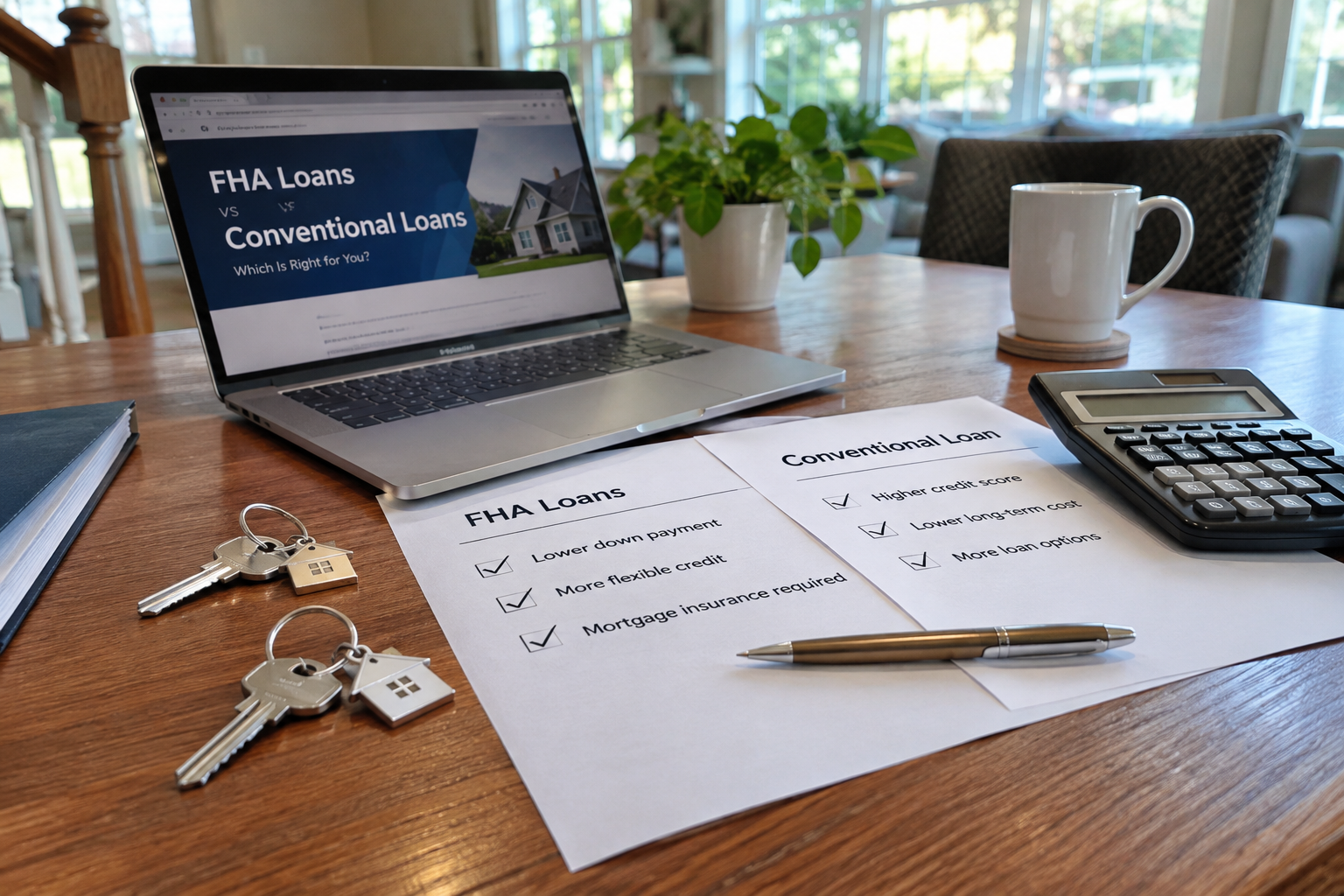
Two of the most common loan types you’ll hear about are FHA and conventional. They overlap in a lot of ways, but the differences matter a great deal for what you’ll pay at closing and every month after. Here’s a plain-English breakdown of how they compare, Before you compare the two, it helps to already know your price range — our guide to getting pre-approved for a mortgage covers that first step. Here’s a plain-English breakdown of how they compare, so you can have a smarter conversation with your lender.
The down payment difference
FHA loans require as little as 3.5% down, while conventional loans can go as low as 3% for qualified buyers. On paper those numbers look close. In practice, the right choice often comes down to your credit and how much cash you’ve saved.
Both are far below the 20% figure many people assume they need — our down payment guide walks through the full picture of what you’ll actually need. The real question isn’t whether you can buy with a small down payment, it’s which small-down-payment program fits your overall financial picture.
Worth noting: with a bigger down payment, the calculus changes. A conventional loan with 20% down lets you skip mortgage insurance entirely, which is a meaningful monthly saving. FHA doesn’t offer that same clean off-ramp.
If cash is tight, both programs are workable, but don’t let the small down payment be the only thing you compare. The monthly mortgage insurance and the total interest you’ll pay over time often matter more than the upfront amount.
Credit score requirements
FHA loans are generally more forgiving of lower credit scores. That’s the program’s whole point, to open homeownership to people whose credit history isn’t perfect. Many FHA borrowers have scores that would make a conventional loan harder to get.
Conventional loans tend to reward stronger credit with better pricing. If your score is solid, a conventional loan often costs less overall, even with mortgage insurance factored in. If your credit is a work in progress, FHA may be the more realistic path.
These are general patterns, not hard rules. Lenders set their own overlays on top of program guidelines, so the only way to know your actual options is to get pre-approved and see what a lender offers.
If you’re not sure where your credit stands, pull your own report before you talk to a lender. Knowing your score ahead of time helps you set realistic expectations and avoid surprises during pre-approval.
Mortgage insurance: MIP vs PMI
Both loans charge you for the risk of a small down payment, but they do it differently. FHA charges a mortgage insurance premium, or MIP, which has an upfront portion and an annual portion. Conventional loans charge private mortgage insurance, or PMI. If you’re weighing rate structure too, our fixed vs adjustable-rate mortgage guide explains the other big decision on the table.
The key difference is how long it lasts. On an FHA loan with a down payment below 10%, MIP typically stays for the life of the loan. PMI on a conventional loan can be removed once you reach enough equity, either automatically or by request.
That longevity difference matters. If you plan to stay in the home a long time, the ability to drop mortgage insurance on a conventional loan can represent real savings. If you’re not sure how long you’ll stay, the comparison gets more nuanced.
A lender can model exactly what each type of insurance will cost you on the home you want. Seeing those dollar figures side by side is usually the moment the right choice becomes obvious.
Which borrower fits each loan?
FHA tends to fit buyers with lower credit scores, smaller down payments, or recent credit events like a bankruptcy. It’s also a common choice when a borrower’s debt-to-income ratio is on the higher side, since FHA guidelines can be more flexible there.
Conventional tends to fit buyers with stronger credit who can put at least 3% down and want the option to drop mortgage insurance later. If you have military service, there’s a third path worth checking first — our VA loan guide covers it. It’s also the default choice for buyers who don’t want the specific property requirements that come with FHA.
There’s no universal right answer. Two buyers with the same income and savings might land on different loans because their credit, plans, and goals differ. That’s why a side-by-side comparison from a lender is more useful than any general rule.
One more consideration: if you’re buying with a gift toward your down payment or using a down payment assistance program, check which loan type those funds work with. Some assistance programs pair more cleanly with one loan type than the other.
Property condition and seller considerations
FHA loans come with their own appraisal and property requirements, which are designed to ensure the home is safe and livable. In a competitive market, some sellers prefer conventional offers because they perceive fewer hoops to jump through.
Conventional appraisals still check the home’s value and condition, but the standards can be less prescriptive. For certain homes, especially older properties, FHA’s requirements can trigger repair negotiations that a conventional loan might not.
This is where a local agent earns their keep. They can help you understand which homes are more or less likely to sail through each type of appraisal, and how to make your offer competitive regardless of the loan you’re using.
Neither loan is inherently better in a seller’s market. What matters is that your agent and lender work together to package your offer well, whether that means a strong pre-approval letter or a conversation with the listing agent about your financing.
When you might refinance between the two
Your loan choice at purchase doesn’t have to be permanent. Plenty of buyers start with an FHA loan to get in the door, then refinance into a conventional loan once their credit improves or their equity grows enough to drop mortgage insurance.
The reverse happens less often, but it’s not unheard of. A borrower who wants a lower monthly payment through a longer term or a different structure might refinance into whichever program now fits their situation better.
The point is to stop thinking of FHA versus conventional as a one-time, forever decision. It’s a choice you make at purchase, and you can revisit it later as your finances change.
Steps to compare your loan options
Start by getting pre-approved with a lender who offers both FHA and conventional loans, not just one. Ask them to run both scenarios with the same home price and down payment so you can see the real difference in monthly payment and cash to close.
Look past the interest rate to the full cost. Compare the down payment, the monthly mortgage insurance, the upfront fees, and how long the insurance lasts. A lower rate with permanent mortgage insurance can cost more than a slightly higher rate you can shed later.
Finally, think about your timeline. If you’ll likely move in a few years, the longevity of FHA mortgage insurance matters less. If this is a long-term home, the ability to drop PMI on a conventional loan could be worth real money.
Frequently Asked Questions
Which has the lower down payment, FHA or conventional?
It’s close. FHA starts at 3.5%, while some conventional programs start at 3%. Conventional can technically be lower, but your credit and other factors determine whether you qualify for that 3% option.
Can I get rid of mortgage insurance on an FHA loan?
If you put less than 10% down, FHA mortgage insurance generally stays for the life of the loan. Many borrowers refinance into a conventional loan later, once they’ve built enough equity, to remove it.
Do I need perfect credit for a conventional loan?
No, but stronger credit gets you better pricing. Borrowers with solid credit often find conventional loans cheaper overall, while those with lower scores may find FHA more accessible.
Which loan is better for a first-time buyer?
Both work for first-time buyers. The better choice depends on your credit score, down payment, and how long you plan to stay. A lender can run both scenarios and show you the real numbers.
Get a side-by-side comparison before you decide
The fastest way to settle the FHA-versus-conventional question is to let a lender run both scenarios with your actual numbers. Until you see real figures, you’re comparing generalities.
If you want help thinking through your financing before you commit, start with our home buyer guide or reach out with your questions.
We’ll help you pick the path that fits your budget and your plans.
Contact Corvin Realty Group at (703) 955-8514 or visit us at 800 Corporate Dr, Suite 301, Stafford, VA 22554.
Related Post
How Much Home Can You Afford in Prince William County, VA?
November 17, 2026
Every buyer asks the same question first: how much house can I actually afford? The honest answer involves more than…VA Loan Guide: Buying a Home in the Prince William County Area
November 3, 2026
If you've served in the military, the VA loan is one of the most valuable benefits you've earned, and it's…Down Payment Guide for First-Time Home Buyers in Virginia
October 27, 2026
If you're buying your first home, you've probably heard that you need 20% down before a lender will take you…Making a Competitive Offer on a Home in Prince William County, VA
October 20, 2026
In a competitive market, finding the right home is only half the battle — the other half is winning it.…Buying vs Renting in Prince William County, VA: Which Makes Sense for You?
October 13, 2026
The decision to rent or buy is one of the biggest financial choices you'll make, and there's no universal right…What to Expect at a Home Inspection in Virginia
October 6, 2026
The home inspection is one of the most important steps in buying a house, yet it's also one of the…How to Price Your Home to Sell in Prince William County, VA
October 1, 2026
Pricing your Prince William County, VA home correctly is the fastest way to sell. Learn how a comparative market analysis…How to Get Pre-Approved for a Mortgage in Prince William County, VA
September 29, 2026
Learn what mortgage pre-approval is, what documents you need, and why it matters when buying a home in Prince William…First-Time Home Buyer Guide: Buying a Home in Prince William County, VA
September 24, 2026
A step-by-step guide to buying your first home in Prince William County, VA — from pre-approval to closing, with local…